About book bindings and the history of book binding.
Bookbinding and the history of book binding is primarily the history of ornamentation of book covers. Before the invention of printing, it was done largely by monks, who prepared the books for further embellishment by goldsmiths and jewelers.
Strips of vellum were replaced by cords at the back of the book during the 12th century in England. The taste for artistic bookbinding soon spread to the court of France. Louis XII and his queen both possessed fine examples of book bindings, probably Italian. Henry II and his wife Catherine de Medici were perhaps the most enthusiastic royal patrons of the book binding art, and the King's favorite, Diana of Poitiers, had one of the finest collections of fine bound books ever assembled up to that time.
According to tradition, oak boards were first abandoned in favor of paper by the workmen who covered the books of the famous printer Aldus of Venice in the 16th century. Previous to this time even small books had stiff covers a quarter of an inch thick.
In the 17th century the use of coats of arms fully displayed in gold, and occasionally in all the colors of the different bearings, became the most common adornment.
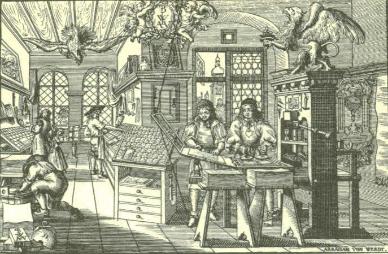
Metal mountings of all sorts provided dignity and sumptuousness. When books were very heavy and very precious, clasps and bosses, four or five on each side, kept the leather and its ornamentation form being rubbed.
In recent times, the binding of books has shown a tendency toward simplicity. As years progressed book binding gradually moved from full leather bound to quarter leather bound, and to cloth. The few exceptions are the production of reference works such as encyclopedias, and collector edition books produced at higher cost. Good examples of the collector edition books are those of the Easton Press and Franklin Library.
With advances in technology, the bulk of books today are mass produced in paperback binding. Modern paperback books are far cheaper than bindings of the past. However modern paperbacks are also produced with cheaper materials which will not last the number of years that fine binding are designed to endure. In essence paperbacks are designed to be almost disposable. One obvious advantage in paperback binding is the size and weight.
It is interesting to note that while many believed the advance of computers and the internet would reduce book production, this is not the case as books are produced today in larger number than ever in history. This can also be said for paper, as computers became more available, so increased the use, and production, of paper worldwide.