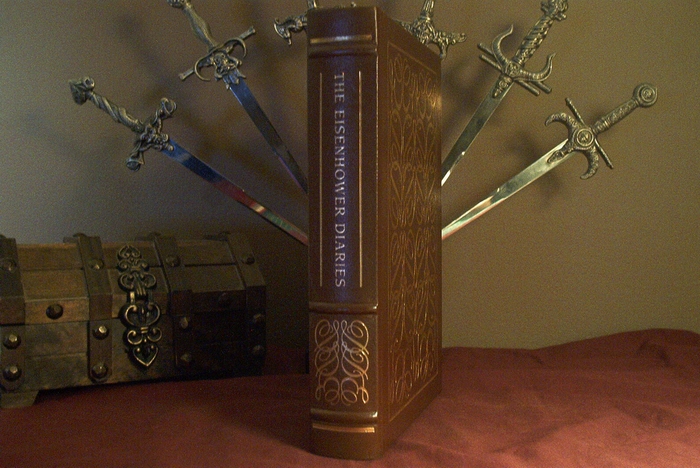
Easton Press Dwight Eisenhower books
Dwight Eisenhower - 2 volumes - Stephen Ambrose - 1987Vol. 1 - Soldier, General of the Army, President Elect 1890 - 1952
Vol. 2 - The President 1952 - 1960
Crusade in Europe - Library of Military History - Dwight D. Eisenhower - 1989
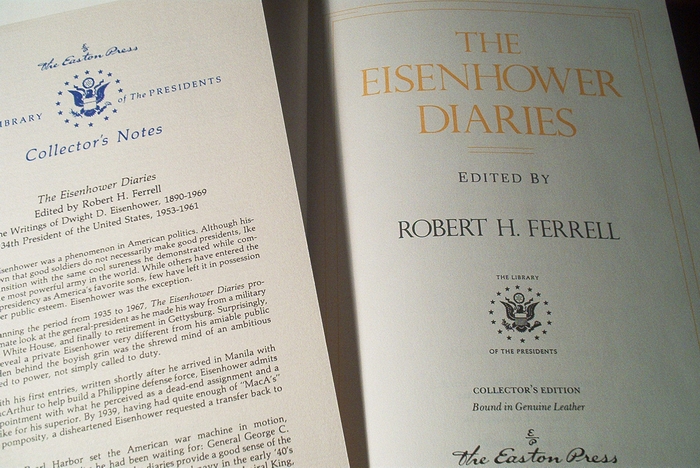
The Eisenhower Diaries - Robert H. Ferrell - 1989
General Ike - John S. D. Eisenhower - Signed First Edition - 2003
President Dwight D. Eisenhower biography
Dwight David Eisenhower (1890-1969), American soldier and 34th President of the Untied States, born in Denison, Texas, and educated at the U.S. Military Academy. His baptismal names were "David Dwight"; his mother called him "Dwight", however, and thus the names were transposed.When Dwight D. Eisenhower was two years old his parents, of Swiss descent, settled in Abilene, Kansas, where he attended the public schools. On his graduation (June, 1915) from military academy Dwight Eisenhower was assigned to the infantry. He married Mamie Doud, the daughter of a prosperous Denver, Colorado, family, on July 1, 1916. On the same day he was promoted to the rank of 1st lieutenant. After the United States entered World War one, he specialized in the newly developed science of tank warfare made commander of Camp Colt, Pennsylvania, a tank training center. There he won a temporary lieutenant colonelcy, which he held until 1920. In that year he received his permanent majority.
Dwight D. Eisenhower was advanced with extraordinary speed following the entry of the United States into World War Two. The months after the Japanese attack on Pearl Harbor he was promoted chief of the War Plans Division of the War Department. In April, 1942he became head of the Operations Division with the temporary rank of major general. Dwight D. Eisenhower was designated commanding general of United States Forces in the European Theater of Operations in June. Dwight Eisenhower's first campaign, initiated on November 7, 1942, with the invasion of North Africa, was marked by repeated successes over the German armed forces, and in January, 1943, President Franklin D. Roosevelt and the British Prime Minister Winston Churchill selected him to lead the projected invasion of Sicily and Italy, He attained the temporary rank of general the same month.
Dwight D. Eisenhower's genius for planning and organization and his ability to win the co-operation of other allied commanders were particularly apparent in his leadership of the early phases of the Sicilian- Italian campaign, which started on May 12, 1943. On December 24, 1943, the Roosevelt and Churchill named him commanding general of the Allied forces in the European Theater of Operations, with the responsibility of organizing the invasion of Western Europe. This operation, named Overlord, was the greatest amphibious undertaking in military history, and began on June 5, 1944, with Dwight Eisenhower as supreme commander. He retained supreme command until the surrender of Germany on May 8, 1945. In the meantime he had been promoted to the temporary rank of General of the Army (Dec. 20, 1944). His five-star status was made permanent in April 1946.
After serving as supreme commander of the United States occupation zone in Germany and on the Allied Control Commission, Dwight D. Eisenhower was recalled to Washington, D.C., in November, 1945, to succeed General of the Army Marshall as chief of staff. In this post he was an outspoken advocate of universal military training and of unification of the armed forces. Having accepted an invitation to head Columbia University, he retired from the army on May 2, 1948, and on June 7 became the 13th President of Columbia University. At the request of President Harry S. Truman he obtained an informal leave of absence from Columbia in February, 1949, in order to serve as temporary chairman of the Joint Chiefs of Staff. This assignment, essentially to help accelerate unification of the armed services, terminated in August, 1949.
Dwight D. Eisenhower was recalled again to military service on December 19, 1950, by President Truman at the request of the North Atlantic Treaty Organization Council, a body consisting of the foreign and defense ministers of the signatories of the North Atlantic Treaty. Early in January, 1951, in Paris, he assumed his new duties as supreme commander of the integrated European Defense Force, which the council authorized for the purpose of meeting the threat of Soviet aggression in Europe. Three months later he completed organization of Supreme Headquarters, Allied powers of Europe (S.H.A.P.E). By the close of 1951 forces of the multinational army under his command included about twenty combat ready divisions.
Meanwhile, beginning in the autumn of 1951, Governor Thomas Edmund Dewey, Senator Henry Cabot Lodge, and other leaders of the Republican Party had engendered a vigorous Eisenhower for President Boom. Dwight Eisenhower, who had rebuffed attempts by Republicans and Democrats to make him a candidate in 1948, tacitly approved the movement in a statement (January 7, 1952) indicating his willingness to become the Republican nominee if he received a "clear cut call to political duty". The pro-Eisenhower Republicans thereupon intensified their activities, entering a long series of State-primary and State-convention contests for delegates to the Republican National Convention. In April Dwight Eisenhower requested relief from his duties in Europe. He arrived in Washington, D.C., on June 1, resigned from the army on June 2, and on June 4, in a speech at Abilene, launched his campaign for the nomination. Spurred by his participation, the pro-Eisenhower movement gained irresistible momentum in subsequent weeks. He won the nomination of the first ballot of the Convention, receiving 845 votes to 280 for Senator Robert Alphonso Taft, the other leading candidate.
In the election held on November 4, Dwight D. Eisenhower carried 39 States, including 4 States in the South, winning 442 electoral votes to 89 for his Democratic opponent, Governor Adlai Ewing Stevenson of Illinois. The Republican candidate's popular vote totaled almost 34,000,000, more than 6,500,000 greater than Stevenson's and the largest ever received by a Presidential nominee.
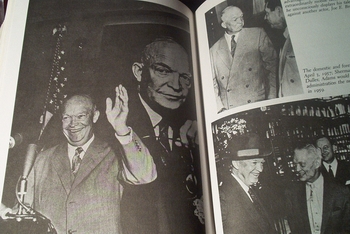
President Dwight D. Eisenhower visited Korea in December, and during the first half of 1953 the problem of securing a cessation of hostilities was his primary concern. Korean armistice negotiations, which had been suspended late in April, 1953. A truce agreement was signed in July. Concurrently President Eisenhower carried through a basic reappraisal of the international situation. On the basis of indications that the Soviet Union was not likely to start a major war in the foreseeable future, he cut the defense budget prepared by President Truman's administration by $5.2 billion.
In a dramatic move to halt the growing atomic armaments race President Dwight D. Eisenhower proposed that the Soviet Union and other nations participate with the Unites States in the creation of an international bank of fissionable materials for peacetime uses.
President Dwight D. Eisenhower suffered an attack of coronary thrombosis on September 24, 1955. His response to treatment was rapid and satisfactory and by January, 1956, he was able to resume most of his duties. On February 27, he announced his availability for a second term.
The Republican National Convention, held in San Francisco in August, unanimously re-nominated President Dwight D. Eisenhower. Re-elected President in the national election, of November 6, he received about 58 percent of the popular vote and carried 41 States with a total electoral vote of 457 against 73 electoral votes for the Democratic opponent Adlai E. Stevenson. However, the Republican Party failed to win a majority in either house of Congress.
On January 17, 1961, President Dwight D. Eisenhower made his farewell address to the nation. In March Congress restored to Dwight D. Eisenhower his rank of General of the Army.
Eisenhower, Soldier, General of the Army, President-Elect, 1890-1952
Eisenhower:
Soldier, General of the Army, President-Elect by Stephen Ambrose is a
riveting biography that delves into the remarkable life of Dwight D.
Eisenhower, one of America's most revered leaders. From his humble
beginnings in Kansas to his rise as a five-star general and ultimately
to his election as President of the United States, Eisenhower's journey
is chronicled with depth, insight, and admiration by Ambrose. With
meticulous research and engaging prose, Ambrose captures Eisenhower's
unparalleled leadership, strategic brilliance, and unwavering dedication
to his country, offering readers a compelling portrait of a man who
left an indelible mark on history.
Eisenhower, The President
The President 1952-1960 by Stephen Ambrose offers a captivating exploration of one of the most pivotal periods in American history through the lens of Dwight D. Eisenhower's presidency. Ambrose, renowned for his meticulous research and compelling narrative style, delves into Eisenhower's leadership during a time of profound change and challenges, from the Cold War to the Civil Rights Movement. With vivid detail and insightful analysis, Ambrose paints a vivid portrait of Eisenhower's presidency, revealing the complexities of the man behind the office and the enduring impact of his leadership on the nation and the world.
Crusade in Europe
Crusade
in Europe by Dwight D. Eisenhower offers readers a firsthand account of
one of the most consequential campaigns of World War II as seen through
the eyes of its supreme commander. Published in 1948, Eisenhower's
memoir provides a detailed and insightful narrative of the Allied effort
to liberate Europe from Nazi tyranny. Drawing upon his experiences as
the Supreme Commander of the Allied Expeditionary Force, Eisenhower
offers a comprehensive overview of the planning, execution, and
aftermath of the D-Day invasion and the subsequent campaign across
Europe. With candor and clarity, he recounts the challenges faced by
Allied forces, the strategic decisions that shaped the course of the
war, and the sacrifices made by soldiers and civilians alike.
Eisenhower's
writing is marked by a sense of humility and gratitude, as he pays
tribute to the bravery and resilience of the men and women under his
command. From the beaches of Normandy to the liberation of Paris and the
final victory in Berlin, Crusade in Europe offers a gripping firsthand
account of one of the defining moments of the 20th century.
Beyond
its value as a military history, Eisenhower's memoir also provides
valuable insights into the complexities of leadership and diplomacy
during wartime. As Eisenhower navigates the intricacies of coalition
warfare and manages the competing interests of Allied leaders, readers
gain a deeper appreciation for the strategic acumen and political skill
that characterized his command. Crusade in Europe stands as a testament
to Eisenhower's legacy as both a military leader and a statesman.
Through his vivid storytelling and keen analysis, Eisenhower offers
readers a compelling portrait of the triumphs and challenges of the
Allied campaign in Europe, while also reflecting on the broader lessons
of war and the enduring quest for peace.
The Eisenhower Diaries
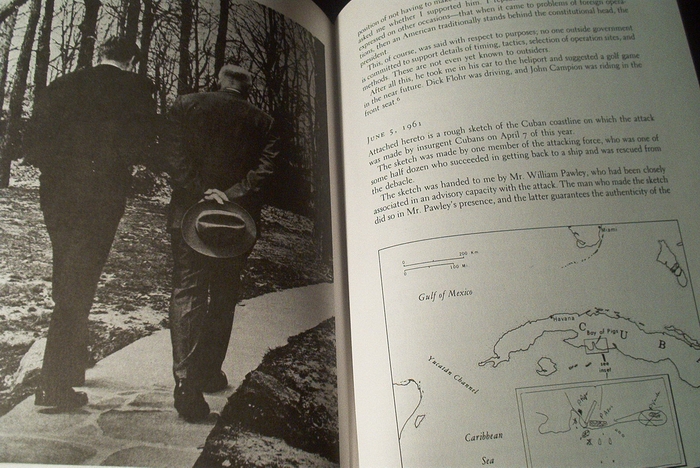
The Eisenhower Diaries offers readers a unique and intimate glimpse into the life and mind of Dwight D. Eisenhower, one of America's most revered leaders. Compiled and edited by Robert H. Ferrell, this collection of Eisenhower's personal diary entries provides invaluable insight into his thoughts, feelings, and experiences throughout his presidency and beyond. Born on October 14, 1890, in Denison, Texas, Eisenhower rose through the ranks of the U.S. Army to become a five-star general during World War II, leading the Allied forces to victory in Europe. His leadership and strategic brilliance earned him widespread acclaim and paved the way for his eventual presidency.Throughout his time in office from 1953 to 1961, Eisenhower kept meticulous records of his daily activities, meetings, and reflections in his diaries. From discussions with world leaders to moments of personal introspection, these entries offer a candid and unfiltered look at the challenges and triumphs of Eisenhower's presidency. As president, Eisenhower grappled with a wide range of issues, from the Cold War and nuclear arms race to civil rights and domestic policy. His diaries reveal his deep commitment to public service, his pragmatic approach to governance, and his unwavering dedication to the American people.
Moreover, The Eisenhower Diaries shed light on Eisenhower's life beyond the presidency, including his retirement years and reflections on his legacy. Through his own words, readers gain a deeper understanding of Eisenhower as a leader, a husband, a father, and a citizen, as well as the enduring values that guided his life and career. The Eisenhower Diaries is more than just a historical document; it is a testament to the enduring relevance of Eisenhower's legacy and the power of personal reflection. Through his candid and insightful writings, Eisenhower offers readers a window into his world, inviting them to share in his experiences and learn from his wisdom.
Eisenhower quotes
"Plans are nothing; planning is everything.""The supreme quality for leadership is unquestionably integrity. Without it, no real success is possible, no matter whether it is on a section gang, a football field, in an army, or in an office."
"What counts is not necessarily the size of the dog in the fight - it's the size of the fight in the dog."
"In preparing for battle I have always found that plans are useless, but planning is indispensable."
"Every gun that is made, every warship launched, every rocket fired, signifies in the final sense a theft from those who hunger and are not fed, those who are cold and are not clothed."
"Motivation is the art of getting people to do what you want them to do because they want to do it."
"Only strength can cooperate. Weakness can only beg."
"Pessimism never won any battle."
"If you want total security, go to prison. There you're fed, clothed, given medical care and so on. The only thing lacking... is freedom."
"Farming looks mighty easy when your plow is a pencil and you're a thousand miles from the corn field."
No comments:
Post a Comment
Share your best book review and recommendation