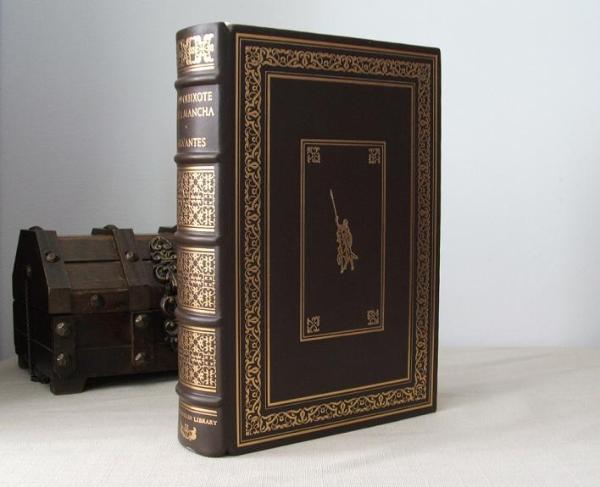
Easton Press Miguel de Cervantes books
Don Quixote de La Mancha - 100 Greatest Books Ever Written - 1979
Franklin Library Miguel de Cervantes books
Don Quixote de La Mancha - Great Books of the Western World - 1978
Don Quixote de La Mancha A Sequel - Great Books of the Western World - 1982
Three Exemplary Novels - Collected Stories of the World's Greatest Writers - 1983
Miguel de Cervantes biography (1547 - 1616)
Miguel de Cervantes Saavedra was a Spanish novelist, born in Alcala de Henares, and educated at the College of the City of Madrid. His father was an indigent doctor with a large family. Although Cervantes grew up in poverty, he managed to obtain a fair education. In 1568 a number of his poems appeared in a volume published in Madrid to commemorate the death of the Spanish Queen Elizabeth of Valois (1545 - 1568). He went to Rome in 1569, and there in the following year he entered the service of Giulio Cardinal Acquaviva. Soon after ward Cervantes joined a Spanish regiment in Naples. He fought in 1571 against the Turks in the naval battle of Lepanto, in which he lost the use of his left hand. While returning to Spain in1575 Cervantes was captured by Barbary pirates. He was taken to Algeria as a slave and held there for ransom. During the next five years he made several heroic but unsuccessful attempts to escape, and was finally ransomed in 1580 by his family and friends.
Back in Spain at the age of thirty-three, Cervantes, despite his wartime service and Algerian adventure,was unable to obtain employment with a noble family, the usual reward for veteran soldiers who had distinguished themselves. Deciding to become a writer, he turned out poems and plays at a prodigious rate between 1582 and 1585. Only two of the plays of this period, El Trato de Argel and La Numancia, are extant. His pastoral novel Galatea (1585) gained him a reputation, but the proceeds from its sale were insufficient to support him. Cervantes then took government jobs, first as a Seville commissary furnishing goods to the fleet of the Armada, and later (1594) as a tax collector in Granada. In the latter capacity he entrusted a large sum of government money to a merchant who absconded with it. Cervantes managed tomake good the loss, but the government imprisoned him for three months because he failed to render a satisfactory account of his activities as tax collector.
While in prison he conceived the idea for a story about an amusing madman who imagines himself a knight-errant performing the splendid feats described in medieval tales of chivalry. In 1601 the first part was issued under the title Don Quixote de la Mancha or in English Don Quixote de la Mancha, 1612. It became such an immediate success that within two weeks after publication three pirated editions appeared in Madrid. Partly because of the pirating and partly because of his lack of financial acumen, the enormous success of the work never brought Cervantes any substantial wealth.
His Novelas Ejemplares or in English Exemplary Novel, 1613, a collection of twelve short stories, includes romance in the Italian style, descriptions of criminal life in Seville, and sketches of unusual events and characters. Two of these stories, Rinconete y Cortadillo and El Cologuio de los Perros (in English - The talking Dogs), are renowned for their prose style. The second part of Don Quixote was published in 1615. Four days before he died Cervantes completed the fantastic novel Persiles y Sigismunda (1617).
Don Quixote de la Mancha
Miguel de Cervantes' masterpiece Don Quixote is generally regarded as the first modern novel and as one of the greatest novels ever written. Influenced somewhat by the epic poem Orlando Furioso by the Italian poet Lodovico Ariosto, Don Quixote is a brilliant satire, not only of the chivalric romances of the Middle Ages and early Renaissance, but also of the sentimental and pastoral novels popular in Cervantes' own time. Its protagonists, Don Quixote is the incurable romantic, cherishing the chivalric ideals of a bygone age; Sancho Panza, by contrast, emerges as the quintessence of folk simplicity and worldly astuteness. The tale of their adventures together ranges across a broad panorama of the 16th century Spanish life, brilliantly depicting the countryside with its bare landscape and dusty roads, the wretched inns and crafty innkeepers, the seedy aristocrats and stubborn peasantry. The folk irony, the puns, and the witty repartee which enliven the writing form an integral part of Cervantes' style in Don Quixote.
Despite the sadness and disillusionment expressed by Don Quixote's misadventures, the novel is fundamentally an optimistic work. The concept of a man who seeks to live by the chivalric ideals of manhood, virtue, and honor is only partially satirical. In the person of Don Quixote is also a basic affirmation of those humanistic values which were under attack in Cervantes' Spain by the Inquisition. Don Quixote has influenced, either directly or indirectly, nearly all subsequent novels; such as famous British novelists, for example, as Tobias Smollett, Henry Fielding, and Charles Dickens owe much to Miguel Cervantes clear sighted, comic approach to reality.
Don Quixote, or in full The History of Don Quixote de la Mancha, a satirical novel and one of the masterpieces of world literature, by Miguel de Cervantes Savedra, originally published in two parts (1605 and 1615). According to tradition, Cervantes began to work on Don Quixote while serving a term in prison. His purpose in writing the book was, in his own words, "to diminish the authority and acceptance that books on chivalry have in the world and among the vulgar".
The principal character of the novel is Don Quixote, an elderly village gentleman of modest means. An avid reader of old-fashioned tales of chivalry, he becomes obsessed with the idea of reintroducing the practice of knight-errantry into the world. Don Quixote equips himself with arms and armor and rides forth on Rosin ante, a caparisoned old nag, to challenge evil wherever he may find it. He is accompanied on foot by the loyal and shrewd, but credulous, peasant Sancho Panza, who serves him as squire.
In his deranged state, Don Quixote sets himself the task of defending orphans, protecting maidens and widows, befriending the helpless, serving the causes of truth and beauty, and re-establishing justice. His adventures and skirmishes are often grotesquely inappropriate to the situation at hand, e.g., he attacks a windmill, thinking it a giant, and a flock of sheep, thinking it an army. The obstinacy of his illusions never permits him to yield to the warnings of Sancho Panza, whose attitude is as realistic as his master’s is idealistic. The philosophical perception of the novel lies in the suggested balance of their contrasting views.
In part 11 the contrast between Don Quixote’s romanticism and Sancho Panza's practical wisdom is less striking. Don Quixote becomes a trifle more reasonable, and Sancho Panza begins to understand rather dimly his master’s illusions. In the end Don Quixote returns to his village and abandons knighthood. He realizes the error of his ways, declaring that "in the neat of yesteryear there are no birds today", falls ill, and dies. Critics generally agree that part two of Don Quixote is superior because of its more compact organization.
Don Quixote has had an enormous influence on the development of prose fiction; it has been translated into all modern languages and has appeared in some seven hundred editions. Its first publication in English was in translation by Thomas Shelton in 1612. It has been the subject of a variety of works in other fields of art, including operas by the Italian composer Giovanni Paisiello, the French composer Jules Massenet, and the Spanish composer Manuel de Falla; a tone poem by the German composer Richard Strauss; a German movie directed by George Wilhelm Pabst, and a Soviet-Russian movie directed by Grigori Kozintzev; book illustrations by the French artist Gustave Dore; and a number of paintings by the French artist Honore Daumier.
With its experimental form and literary playfulness, Don Quixote has been generally recognized as the first modern novel. The book has been enormously influential on a host of writers, from Fielding and Sterne to Flaubert, Dickens, Melville, and Faulkner, who reread it once a year, "just as some people read the Bible."
Three Exemplary Novels
No comments:
Post a Comment
Share your best book review and recommendation